Falk family’s former farm
The DryThe Falk family’s former farm is both a specific farmhouse on the edge of Aaron Falk’s remembered landscape and a physical marker of the life he left behind. When Falk follows an old path to the childhood home, its changed appearance draws him into memories of family life and of his father, Erik Falk. He does not reach the porch: a woman who now lives there treats his presence as another intrusion connected to events from twenty years earlier. The place therefore holds two histories at once—Falk’s private attachment to home and its current occupants’ fear of renewed harassment.
Setting and approach
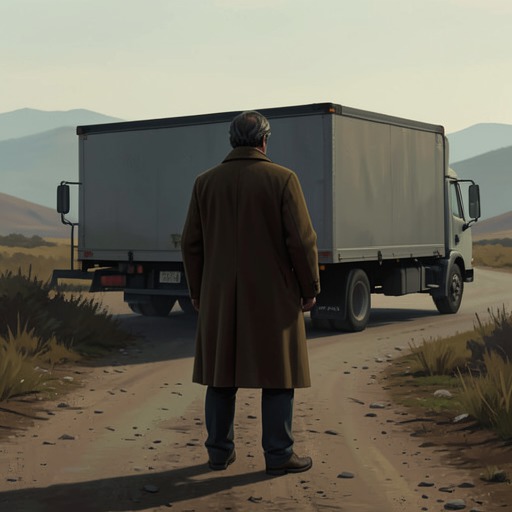
Falk reaches the farmhouse by way of the Rock tree and a nearly vanished trail leading away from the dusty river and into the bushland. The Hadler Farm and his car lie in one direction; the old route lies in the other. He has walked it countless times, and its disappearance from the landscape has not erased it from his memory. The path offers a way back to a place he knows, but not an uncomplicated return: he pauses before taking it, weighing the choice before continuing.
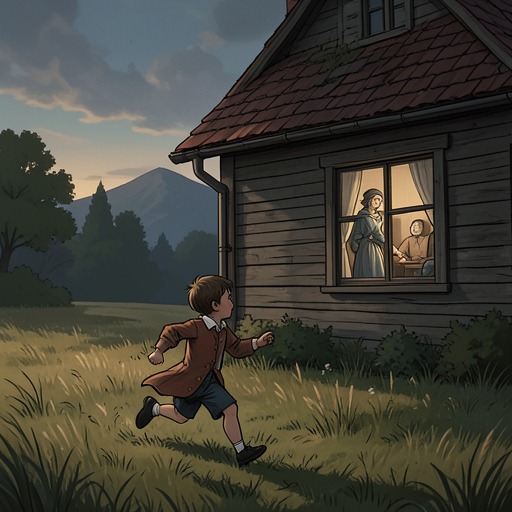
The walk takes only a few minutes. By the time Falk emerges from the trees, the sky has darkened to indigo, and the farmhouse is visible across a field. He crosses directly toward it, as he had always done, but slows as he approaches. He stops about twenty metres from the building. This distance matters: he has come close enough to examine the house, but remains outside its immediate boundary, neither entering nor presenting himself as someone entitled to go in.
The childhood home in memory
The farmhouse’s small changes make time visible to Falk. The porch door, once yellow, is now blue, with worn paint exposing patches of the old color beneath. The wooden steps where he once sat with toys and football cards sag with age, and a discarded beer can rests in the grass below them. Falk feels an impulse to remove the rubbish and repair or repaint the house. Instead, he holds back. The repairs he imagines would be acts of care, but the house is no longer his to maintain.
A single lit window, its glow coming from a television, prompts a more intimate recollection. Falk remembers his father appearing at the screen door in the evening to call him inside for dinner, a bath, and bed. His father rarely spoke about Falk’s mother. As a child, Falk nevertheless tried to imagine her presence in the house, touching familiar fittings and household objects and picturing her in the rooms. The building thus carries memories not only of his father’s routines but also of a mother whose absence shaped his childhood imagination.
Falk understands that he and his father had once been happy there. Looking at the farmhouse now, he experiences it as a dividing line in his life, marking a before and an after. The force of that recognition turns partly into anger at himself for coming. He retreats from the consoling idea that the house still contains something of his family: he tells himself that it is simply another building needing repair, and that nothing of him or his father remains there.
Present occupants and the past
As Falk turns to leave, a woman opens the screen door and comes outside. She is the current occupant he encounters; the passage does not identify her by name. Her initial response is suspicious, and Falk notices that she does not recognize him. He considers explaining himself, but does not immediately do so. Although he could show his police badge, he is embarrassed to be standing outside a stranger’s home without a clear excuse.
The woman briefly turns back into the house to answer someone inside, then returns to speak with Falk. She warns him to leave, explaining that the man inside has been drinking and may not react well if he comes out. She also rejects any connection between the household and what happened in the past, including any involvement by the man’s mother. Her response makes clear that the property is not merely a private landscape of Falk’s childhood: it is now a home occupied by people who feel exposed to the repercussions of an older local history.
Falk steps back and raises his hands to appear unthreatening, apologizing for upsetting either of them. The woman answers that the house has been bought and paid for and that its occupants will not accept further harassment. She invokes the passage of twenty years and presents the visit as part of a pattern of attention they believe should have ended. Her account does not explain the earlier events in detail, but it establishes their continuing effect on those who live at the farmhouse.
Significance
The scene contrasts Falk’s intimate memories with the occupants’ understanding of the same place. To him, the faded paint, sagging steps, and lit window open onto childhood and family loss; to the woman, an unannounced visitor represents the return of unwanted scrutiny. Neither perspective makes the house simply a relic: it is both a home Falk remembers and a present-day residence whose occupants claim the right to be left alone.
The nearly erased trail and the farmhouse’s visible deterioration give physical form to the difference between memory and ownership. Falk can still follow a route he has walked a thousand times, but familiarity does not restore his place in the household. He stops short, declines to make repairs, and ultimately backs away when asked. The former farm consequently marks not a recovered homecoming but the limit of return: Falk can revisit the setting of his childhood, yet it belongs to other people and remains entangled in a past they do not want reopened.